


There are moments in a performance when it’s obvious that there’s far more behind a song than the words written for it. The literal song may be the same, but the person singing it isn’t. They have lived an entirely different life since writing it, and that can change everything, so much so that the effect is tangible.
Glen Hansard died July 29, 2026, at age 56, following a single-vehicle motorcycle crash in Dublin. Hansard was born in Dublin, Ireland, and raised in the suburb of Ballymun.
Hansard performed Tuesday night, just hours before he lost his life at The Wren’s Nest in Chapelizod, a pub whose weekly traditional Irish music sessions made him a regular, according to RTÉ. Captured on video, Hansard is seated in the middle of a near-silent audience with his guitar, the clock reading 11:15 p.m. At approximately 4:30 a.m. Wednesday, Gardaí, Ireland’s national police force, were alerted to Hansard’s single-vehicle motorcycle crash in the Strawberry Beds area of Dublin.
Poignant Video. This was recorded 1 hour before Glen (Rip) was killed. He was in the Wrens Nest, Strawberry Beds at a session. pic.twitter.com/QFTzJ9tLu3
— Joe O’Neill 🐀 (@actingjoe) July 29, 2026
His career spanned bands The Frames and The Swell Season; movies including The Commitments and Once; hit songs such as “Falling Slowly,” which won him an Oscar; and performances with the likes of Eddie Vedder and Pearl Jam. He moved crowds on stages ranging from Grafton Street to the Hollywood Bowl and made numerous television appearances.
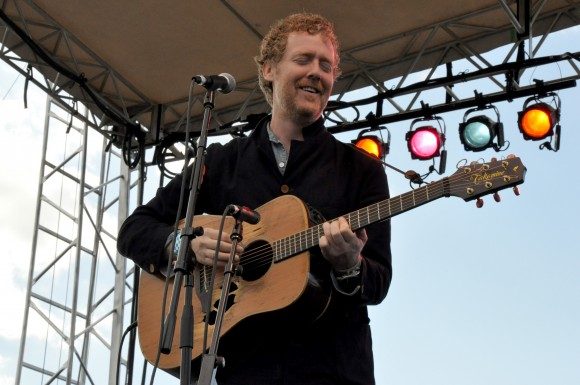
Photo Credit: Alyssa Fried
Looking back at some of the defining moments of Hansard’s career brings together the songs, performances and experiences that made his career what it was, from his early days on Grafton Street to the stages he eventually reached around the world.
In July 2010, Glen Hansard stood on the Hollywood Bowl stage with a guitar in his hands as he sang “Say It to Me Now.”
The Swell Season had already performed much of its set when Hansard returned to the stage alone. Earlier, he and Markéta Irglová had opened with a cover of Tim Buckley’s “Buzzin’ Fly” before the band joined them for Strict Joy songs including “Low Rising,” “In These Arms” and “The Rain.” “Lies” from Once followed, which led to “If You Want Me,” “Leave” and “Back Broke.”
When Hansard introduced “Say It to Me Now,” he told the audience that he had busked the song on Third Street and shared that he and Irglová had dreamed of performing in Los Angeles as the headlining act. He then sang the song he had written all those years ago.
That moment captures what makes Hansard’s career so compelling. Hansard and his music did not have separate lives; his songs reflected his lived experiences from performance to performance. He gripped audiences, struck the cord and knew how to elicit the most powerful audience reaction.
Maybe it was a natural gift, or maybe he honed this potent skill from his youth busking days. Regardless, Hansard knew how to make a song matter to whoever was standing in front of him.
From busking to a stage
Hansard began busking on Grafton Street as a teenager. In a 2022 Hot Press interview, he recalled that he was 15 when he was busking there, explaining that Grafton Street felt like going to another country because his parents had never been to the South Side and they’d never know where to find him.
The Frames formed in 1990, and Hansard’s career soon expanded into film when he was cast as Outspan Foster in Alan Parker’s The Commitments. However, he didn’t let this move overshadow The Frames. When a Frames performance conflicted with an important day of filming, Hansard refused to give up the show, which led to Parker threatening his replacement. Hansard’s response was, “Well, you’ll have to replace me because I’m in a band and that’s what I do.”
The Frames allowed Hansard to turn his enthralling gift into unforgettably deep, authentic moments that would stay with fans for many years to come.
“Star Star”
“Star Star” was featured on The Frames’ 1999 album Dance the Devil… and became part of the band’s live repertoire. It was also on Set List, the live album recorded at Vicar Street in Dublin in 2002. This live recording embodies part of what made The Frames’ performances different from simply performing their studio songs.
RTÉ’s review of the record describes the band’s intense alchemy with its audience, always going the extra mile to turn a concert into a “total experience.” Caroline Hennessy wrote that “from the Willy Wonka moment of ‘Pure Imagination’ in ‘Star Star,’ to the audience participation on new track ‘The Blood,’ the diversion into Bob Marley’s ‘Redemption Song’ on ‘Perfect Opening Line’ and the amp explosion in the middle of ‘Fitzcarraldo,’ the energy never lets up, on either side of the stage.”
Beyond Hansard’s unique ability to create a bond with the audience, The Frames knew how to stretch the boundaries of their own discography. They did this so well that the magical essence of their live performances was translatable to Set List, not an easy feat.
Once
When Once was released in 2007, Hansard had already spent years building his career, but The Swell Season had only just released their self-titled debut album in 2006. Directed by John Carney, the movie starred Hansard and Irglová playing a dramatized version of their own musical pairing, and also put the duo in a new kind of spotlight.
The film’s soundtrack featured “Falling Slowly” from their debut album, which won Best Original Song at the 80th Academy Awards. The song was also included on The Frame’s The Cost, released five months after The Swell Season.
“Falling Slowly” became part of The Swell Season’s live set, including their 2010 Hollywood Bowl performance, where it appeared near the end of the main portion of the concert. It was also given life at Pearl Jam Twenty.
Pearl Jam Twenty
Pearl Jam Twenty took place in 2011 and was a two-day festival celebrating the band’s 20th anniversary. It featured an epic curated lineup that included Hansard, who had previously performed as an opening act on Eddie Vedder’s solo tours.
Following Liam Finn, Hansard took the stage with only his guitar and voice. His passionate acoustic performance commanded attention, but he still began a dialogue with the audience, encouraging sing-a-longs and telling stories.
On the first afternoon, Hansard performed “Falling Slowly” with a lucky audience member. The following day, Vedder joined him for the song, and not only was the warmth between Vedder and Hansard palpable, but it also reflected the overall closeness between the performers and the audience.
He was handpicked to sing background vocals for Pearl Jam’s “Who Are You” (also featuring Liam Finn, Joseph Arthur and Mudhoney’s Dan Peters) and “Smile,” along with Temple of the Dog’s “Say Hello 2 Heaven” and “Reach Down,” which also included Liam Finn, Dhani Harrison and David Garza. Hansard, of course, was also part of the massive, all-guest-inclusive finale of the Neil Young cover “Rockin’ in the Free World.”
While a festival of this caliber put Hansard in front of an enormous audience, his performance remained candid, personal and upbeat despite his heavy material.
No matter the venue
Hansard’s career flowed between enormous stages and smaller venues. In December 2009, he returned to Grafton Street for the Christmas Eve charity busk, performing alongside Bono, Damien Rice and Hozier to raise money for the Simon Community. The return was part of a tradition that connected Hansard’s international career with the street where he had first learned to perform for an audience.
Sure, the place was familiar, but he was no longer the teenager who was playing guitar on Grafton Street. He had The Commitments under his belt now. He had spent years recording and touring with The Frames. He had made Once with Irglová, won an Oscar and formed The Swell Season. But he was still more than willing to stand on that street and play.
His ability to perform in places as different as Grafton Street and the Hollywood Bowl showed that the size of the venue did not determine the kind of connection he sought with an audience. The voice, the guitar, the song, all remained at the center of the performance. And at the Hollywood Bowl, one of his oldest songs brought all those years into the same moment.
“Say It to Me Now”
When Hansard introduced “Say It to Me Now,” his storytelling capabilities were on full display as he shared with the audience how he had busked the song on Third Street before and had dreamed of this very moment with Irglová. Now, here they were, living that dream on the Hollywood Bowl stage.
In his performance, Hansard captured the 15 years that sat between when he wrote the lyrics and when he was convincingly belting them in that moment. “You could feel the ocean of experiences between the point they were written over fifteen years ago and now,” wrote mxdwn Editor-in-Chief Raymond Flotat. The moment felt like a dream fulfilled.

Photo credit: Stephen Hoffmeister
Hansard had told the audience about imagining this moment, and now he was standing in it, singing the song that had been part of his life long before headlining the Hollywood Bowl was within reach. The audience could hear how that earlier hope had come to fruition, not because he needed to explain what that moment meant, but because the song itself had traveled with him from one part of his life to another.
The full band returned for the end of the performance, and The Swell Season closed with Bruce Springsteen’s “Drive All Night,” followed by “The Parting Glass.” It was a performance with a clear message: pursue one’s ambition with confidence, to find joy in the darkest pits of despair and refuse to let any darkness rob you of your happiness.
Returning to where he began
Grafton Street was never really erased from Hansard’s life. He started the Dublin Christmas Eve Busk right on Grafton Street, which eventually was moved to outside the Gaiety Theatre. The annual charity event raised funds and awareness to fight homelessness. According to The Irish Times, he had an aunt who battled alcoholism and died homeless on a park bench in Birmingham, Ireland on Christmas Day.
At his funeral, Vedder performed Hansard’s “The Song of Good Hope” with Irglová and members of The Frames. After its conclusion, Vedder went to Grafton Street and played Pearl Jam’s “Black” and Bruce Springsteen’s “Drive All Night” alongside other musicians.
The songs do change
Hansard’s career has many landmarks: The Frames, The Commitments, Once, “Falling Slowly,” winning an Oscar, The Swell Season, his solo projects, Pearl Jam Twenty and the Hollywood Bowl, and he carried his music through all of them.
“Say It to Me Now” had already been part of Hansard life when he told the crowd at the Hollywood Bowl about busking on Third Street years earlier. By then, the distance between where the song began and where he was singing it had become part of the performance itself.
He understood that songs were not fixed. In a 2025 Hot Press interview, when asked whether the older songs they perform change over time, Hansard answered, “The songs do change.” He explained that the songs can take on different feelings as the musicians performing them change, or with the personnel or as he and Irglová found themselves singing from a different place since their relationship had deepened and broadened.

Photo credit: Alyssa Fried
“Following Slowly” moved from Once, to the Academy Awards, through The Swell Season and eventually onto a stage with Eddie Vedder. “Say It to Me Now” took Hansard from a street in Los Angeles to the Hollywood Bowl. His music was a part of him that changed as he did.
Even after his passing, that connection remained. Hansard began performing as a teenager on Grafton Street. Decades later, Eddie Vedder returned to that street along with Bono, The Edge, Hothouse Flowers singer Liam Ó Maonlaí and Markéta Irglová to perform in his honor.
Hansard spent his life carrying songs from one place to another. What they gathered along the way, who they were performed with, who he was in that moment, the audience in front of him, all manifested together to create riveting, palpable experiences.
It’s a tragically beautiful thing that, after Hansard was gone, his music found its way back to the street where so much of his story began. Vedder played Hansard’s own guitar as he sang “The Song of Good Hope” with an aching tenderness.
Featured Image Photo Credit: Owen Ela
