

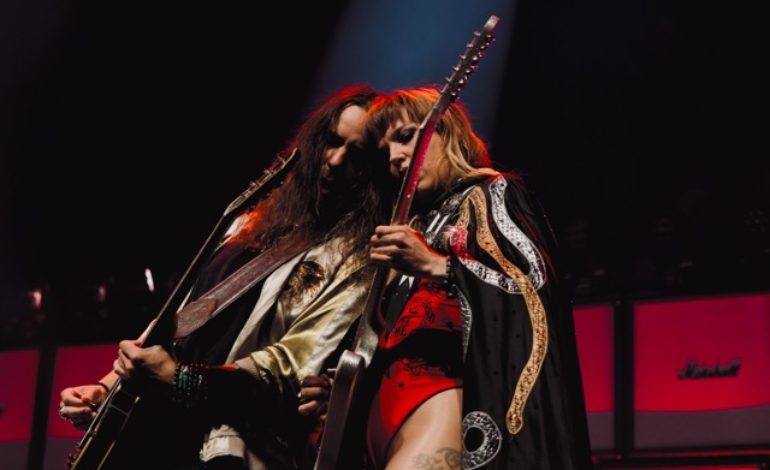
Photo Credit: Colin Hancock
Hailstorm’s lead guitarist Joe Hottinger recently sat down with mxdwn to discuss the band’s surreal experience performing at Black Sabbath’s final show in Birmingham, their relentless work ethic and the creative process behind their upcoming album, Everest, set to release on August 8, 2025. In a candid conversation, Huttinger reflects on the raw energy of their early days, the spontaneity of their latest recording sessions and the magic of connecting with audiences through live performances.
mxdwn: Thanks for taking the time to chat with us, Joe. Where are you calling from? Are you home in Nashville?
Joe Hottinger: Yep, home in Nashville. Got a few days before the next tour starts, so I’m sleeping in my own bed. It’s great, though I wish it was downtime.
mxdwn: As a huge Black Sabbath fan, I can only imagine what an honor it was to share the stage with them at their final show in Birmingham. Tell us about that experience.
JH: It was insanity. We got in on Thursday, the show was Saturday—last show of our tour. The buses rolled into Birmingham, and I woke up looking for catering at noon. Tool was rehearsing on stage, sounding incredible. Adam Jones from Tool was such a sweetheart, and the vibes were just electric. Everyone was pumped. Friday, we’re at the supergroup rehearsal with Steven Tyler and Ronnie Wood, just hanging out. Sharon Osbourne was there, so sweet, saying she really wanted us there. It was unbelievable. When Ozzy took the stage, the crowd of 40,000+ was wild. I was in the middle of it, clapping along during “Mama, I’m Coming Home,” and everyone was bawling, singing along. It was the most intense musical experience of my life.
mxdwn: That sounds overwhelming. How did it feel performing in front of that massive crowd?
JH: The crowd was there to celebrate this historical event. We were prepared, but it went by so fast. You walk off stage like, “What just happened? Did we do good?” I watched it back, and it sounded good to me. We didn’t screw up too bad, and being out in the crowd for Ozzy’s set was unreal. It makes you love this music even more. To be invited and feel like we passed the test among all these legends was insanely humbling.
mxdwn: You’ve been a cornerstone of Halestorm for a long time. What’s an early memory that captures the band’s raw spirit from those pre-fame days?
JH: When I met Lzzy, I answered an ad in a Philadelphia music rag. I went to this audition, heard her voice, and thought, “This is cool.” She invited me to rehearse at her house, and RJ was 14, bouncing off the walls. Lzzy and I clicked—she had the same ideas as me, like, “We can do this. We don’t need real jobs.” She was a terrible waitress, serving beer with 75% head. I was like, “You gotta get out of here.” We called 50 bars within 50 miles, put together a four-hour acoustic set for $75 a night, and played four or five times a week. We’d load in our own PA, do our own sound and play 1,500 shows before we got signed. That hustle is still who we are—no click tracks, no computers, just the four of us making noise and chasing the unknown.
mxdwn: You were doing 250 shows a year at one point. Does that road ethic carry over to your studio work?
JH: Totally. Lzzy and I have to force ourselves to turn it off sometimes. We just got home from the Sabbath show, made a music video yesterday and I’m doing interviews, fixing the house and prepping for tour all at once. It’s not just something we do—it’s how we live. The work is getting all the pieces in place for an album release: emails, Zoom meetings, interviews. That’s the only part that feels like work. Playing, writing, recording—that’s the fun part.
mxdwn: You’ve mentioned forcing yourself to listen without a guitar in hand. How does that shape your creative process?
JH: A lot of my favorite riffs are written in my head first. I’ll be zoning out, hear something and think, “What the hell is that?” Then I find it on the guitar. Other times, you pick up a guitar, and the first thing you play has a natural groove. You record it quick to use later. For solos, I rarely improv in the studio—I write them out, work on licks until I can nail them. Improv is for the stage, where it’s my favorite thing to do in front of a crowd.
mxdwn: Your last album, Back from the Dead, was born out of the pandemic’s aggression. How did that experience influence the new album, Everest?
JH: Back from the Dead was a one-and-done. We’re never doing a record like that again, thank God. For Everest, we worked with Dave Cobb in Savannah. We met him in early 2023, wanting to get uncomfortable after three records with Nick Raskulinecz. Dave’s approach was wild—he’d show up at 1 p.m. and say, “Forget your old ideas. Let’s write a song fresh.” We lived in the same house, studio in the basement and recorded in the moment of inspiration. No demos, just capturing the raw excitement. It’s the closest we’ve come to bottling our live energy on a record.
mxdwn: The album art for Everest is striking—very different from your past covers. What inspired that change?
JH: We wanted it to feel like looking at a Sabbath or Dio cover—something that makes you go, “What is this? I want that poster on my wall.” The art has references to the songs, like “Shiver” and “Everest,” with the claw, chain and mystical stairway. It’s about capturing that epic, curious vibe we got from classic album covers, not just another touched-up photo.
mxdwn: After 20 years and so many shows, how do you keep older songs fresh on stage?
JH: Opening for Iron Maiden in Europe was a challenge—diehard fans throwing shoes and coins if you don’t win them over. We had 45 minutes to make them care, so we built relentless sets with moments that make people go, “What the hell was that?” Headlining is different—those fans are there for us, so we change the setlist nightly to keep it fun. The songs belong to the crowd now, and the energy exchange keeps it fresh. Sometimes Amen goes off on a 10-minute jam, and we explore. If it’s working, they ride with us; if not, we move on.
mxdwn: As a gear geek, I loved how you and Lzzy talk about guitars—how every tree is different, so every guitar sounds unique. How does gear tie into your artistry?
JH: Guitars are functional art. I just got a new Les Paul for this tour, and I love playing cool instruments that make people in the crowd go, “What is that?” Like when I saw Tom Petty and Mike Campbell with a ‘57 Les Paul worth 80 grand—it’s part of the show. I’ve got 70-some guitars, all different, and sometimes you pick one up after a while and find a song waiting in it. They’re tools to make art, and on stage, they’re part of the spectacle.
mxdwn: Any final words for your fans as Everest drops on August 8th?
JH: Thanks for taking the time. I hope everyone enjoys Everest. We put out a new song today, “Rain Your Blood,” the last one before the record drops. It’s a good one. Thanks, Ric!
