
 Riley Wilkerson December 1st, 2025 - 12:20 PM
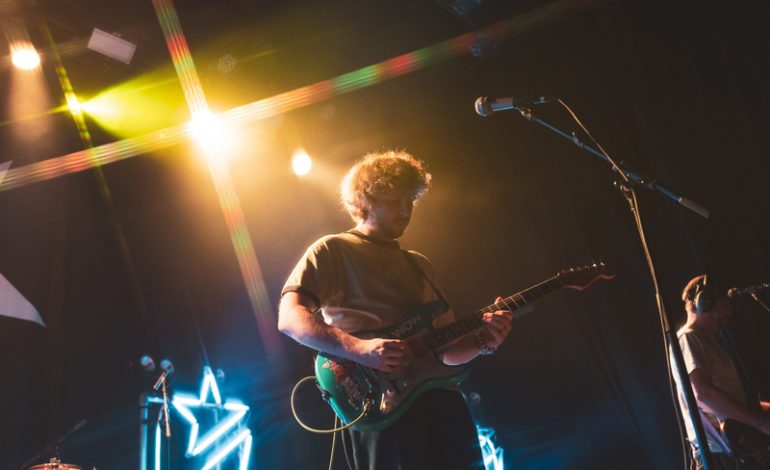
Photo Credit: Mehreen Rizvi
Formed in 2004, New York band Anamanaguchi have ruled like kings over the world of chiptune and 8-bit rock. For years they have built their legacy off of their innovation, breaking down Nintendo consoles and interpolating their sounds with traditional instruments. From collaborating with international popstars to gaining a niche cult following from their work on the Scott Pilgrim game soundtrack, Anamanaguchi have always found themselves at the intersection of creation and excitement.
Their latest album, Anyway, sees Anamanaguchi taking a risk they have never taken in their two decades of being a band: rock music with lyrics. Anyway sees Anamanaguchi take this feat by storm, high-energy guitar riffs paired with thrashing drums, all while a sparks of their chiptune origins sprinkle through. Written entirely during a stay at the iconic American Football house in Urbana, Illinois, Anamanaguchi created a new sound for themselves, a sound that feels like it was theirs all along.
mxdwn had the pleasure of speaking with band guitarist and frontman Peter Berkman as they prepared for rehearsals for their upcoming U.S. tour about the creation of Anyway, their future plans in the Scott Pilgrim franchise and the joy of weezequip.com.
mxdwn: Hello, my name is Riley Wilkerson and today I’m here with Peter Berkman from Anamanaguchi. Hi Peter, how are you doing today?
Peter Berkman: Great, how are you Riley?
mxdwn: Doing great, thank you! I’ll just go ahead and jump right into it. You all just released your fourth studio album Anyway on August 8th, congratulations!
PB: Thank you.
mxdwn: Of course! On Anyway we see you all kind of take a step back from your chiptune, digital beginnings to coming back around to your rock roots. It’s also the first album where we see vocals front and center in your work, as there were lyrical elements in your earlier works, but here we really see it take center stage. How did you all come to the conclusion that you wanted Anyway to go in this direction compared to your previous albums and how does that choice reflect where you all are creatively?
PB: There’s a lot that went into it and living together for a month or so really informed a lot of those decisions. We all live in different places now so we all decided to get together in Illinois, in person. I think we were all frustrated with the world of file sharing and wanted to get back into songwriting. We had all grown up in bands and have lived being in a band, but we’d never really done it in the band we’ve been in for twenty years now. It felt like the time.
mxdwn: Yeah, I love that. I love the visuals too. I have some questions later about the house that you all were living in when writing this album, the American Football house in Illinois, but just that visual of being in a band when you’re younger and being where you all were at just screams garage band. So I love that image with the album, I think it totally fits.
PB: It’s definitely something that we are all familiar with. It was wild to do it at a place that was none of our houses, and none of our parents houses {laughs} for a long period of time. It’s a house that is sort of owned by the band’s parents so to speak, the label Polyvinyl. They bought the house with American Football and the photographer who took that iconic album art that they used. It’s just cool that the place didn’t get destroyed like it probably would have otherwise.
mxdwn: Yeah I remember when the headlines came out in 2023, when Polyvinyl announced that they would be saving it, and everyone was basically rejoicing because we all thought it was going to be torn down. Well now that the record is out in the world and everyone can listen to it, are there any songs that you have been really excited for people to hear, especially as you’re introducing this different sound?
PB: I think our fans, for the most part, actually really super like it. mxdwn did not like it {laughs}.
mxdwn: What?! I loved it! {Laughs} I should have written the review!
PB: {Laughing} Yeah the first review came out from mxdwn that’s on our Wikipedia, I saw it yesterday, and it said something like the album wasn’t cohesive and it’s like “Okay… do you know who we are?” But no, on the whole I think the reception has been really good. I think that’s the only negative review I’ve seen. The song “Sapphire” was a song we actually wanted to leave off the album. Not because we didn’t like it but we had it in our heads that it would be fun to have this vinyl-only song, but obviously that didn’t end up happening. People seem to be gravitating towards that one a lot, which is cool because that song is about the early life of the band coming up in the independent music world in New York. It’s about the chiptune world, which when we were an instrumental band we couldn’t sing about that so one of the first things we decided to do as a band with words in it is sing about our own experience. We’re surprised that our fans really love that one.
mxdwn: I really like that song too. When I first listened to the album it really stood out as a sort of natural bridge between your older, purely instrumental sound compared to this new sound, even though I don’t think this is really far off from your old sound at all. I think they’re actually quite similar.
PB: Yeah totally! I think it’s like a seesaw where on one side you have indie, emo and punk and on the other side you have 8-bit, 16-bit video game music and it’s like that now {laughs).
mxdwn: Yeah, that’s a good metaphor for it! I was gonna say, when researching the creation of the album I couldn’t help but notice that you all said at first you started out wanting to make an album about anger, rage actually, with Anyway. While we do see some of those aspects, especially with the track “Rage (Kitchen Sink)”-
PB: {Laughing} Right, right.
mxdwn: How did it turn from taking those feelings of anger into, which to me, is a really fun, high-energy record? To me it really is the perfect summer album, it made me want to get up and go do something new.
PB: That’s awesome. So much of what we thought the album was going to be came from how we were all feeling before we actually got together. We were all like” Shit!” We were all in pretty terrible moods, honestly. It was like, “Wow, what a horrible state things are in and what do we do?” Even when Luke and I were driving up together, Luke does not have a driver’s license and I do, so we did a twelve hour drive up from Dallas to the American Football house and during that drive we had a lot of downtime and so we called a lot of people. Even the two of us together thought this was going to be an extremely political, mad album. By the time we got to the house it still felt like that. I think we wrote “Rage” and a couple of other things, it was super cathartic to get those things out of our system. Once we were able to do that it felt like, “Now let’s have some fun!” sort of. The phrase I’ve used is, “We got distracted by how much fun we were having together” and I definitely think that shows on the album. Dave Fridmann, who produced it and has this ability to capture the feeling of all of us together in a room and I think it’s just amazing.
mxdwn: Yeah, I saw that as well when I was researching, how Fridmann was very encouraging of doing live takes when it came to the recordings.
PB: Oh yeah. He said from minute one that was how we were going to do it. There’s no going in and noodling or nudging specific parts, just we’ll play it at the same time and get it right and then go from there.
mxdwn: I think that energy really translates to the album. Like I said earlier it’s just so fun and full of energy. Even what we were talking about earlier, about being in bands when you’re younger. It kind of captures that same energy of just untapped fun, making music with your friends.
PB: It’s funny for me to have this low energy at the moment {laughs}, for me at this moment right now. It’s like 10:30 in Dallas right now. I’m definitely more of a night person than a morning person. It’s funny because when we were living at the house, both at the American Football house and at Tarbox Road Studios where Dave records stuff, I found myself waking up naturally at 9 A.M. every day and going to sleep at midnight, or even earlier, every night. There was just such a cool rhythm that we all got into that I’m not used to in my everyday life. I had the energy to have fun, also.
mxdwn: That’s what a good nine hours of sleep every night will do to you. I wanted to ask what was a day in your life like, living in the American Football house when you all were writing and living together? What’s a daily rundown?
PB: Well I slept in the room that’s visible on the album cover.
mxdwn: The window?!
PB: {Laughs} Yeah, the window. I would get woken up by the room getting filled with sunlight, because the window is facing the sun. That would wake me up at around 8:30. When I’d wake up, usually someone else would also be awake. We had this Bialetti coffee maker, which was great. Ary brought it. I don’t know exactly how it works but it’s not an espresso machine, but it does a slow-motion espresso type thing and it’s really awesome.
mxdwn: That sounds really good.
PB: It’s really awesome. We would prepare that, or normally Ary would already be awake and I’d have a cup of that. Then I would go stroll to the coffee shop to grab a bagel, and probably a second coffee {laughs}. That was at Cafe Paradiso. Right now I’m giving someone an Urbana tourist guide {laughs}.
mxdwn: Well what latte would you get?
PB: Well after the Bialetti, I would go with whatever was seasonal there at Cafe Paradiso. That and a jalapeño bagel. That spot is great. I’d come back and normally by that time everyone else would be awake. Our instruments were all set up in the living room so we’d talk about the work that we had done the night and days before and what we wanted to do the next day, then get to practicing for a couple hours. Then probably see who from Polyvinyl was around and get some dinner. It was so cool. It was such a great time. The rhythm of every day was very much: Wake up, hang out, work, hang out, have fun, go to sleep.
mxdwn: That honestly sounds like the perfect schedule.
PB: It was great. I’d do that again in a heartbeat.
mxdwn: I know you all were also the first people to have stayed in the house since Polyvinyl purchased it. How did it feel to be able to work in a place that is so musically significant, especially in the rock and emo scene? Especially being the first people to have the honor to do so.
PB: It’s fun to be on the Wikipedia page for it {laughs}. I don’t know, on one hand it’s absolutely an honor and on the other hand, and this is the hand I feel the most connected to, it’s funny how arbitrary it is, almost. It’s not like the house was particularly important to American Football, or even fans of them, it’s just an image or an icon. You understand after the fact that it’s a real address with real history, but most of that is making the history of the house. {Laughing} And that can be peeing on the house, like a lot of people do, or like Mike Kinsella would do, apparently. For us, there’s the part of the fun of history being what you make it. We want more bands to do this. It was sort of breaking the seal on this thing, turn it from a holy site, a pilgrimage site which it’s marked as on Google Maps, and turn it into something. I’d be cool for that symbol to mean something else to another generation. Not even us, but just to make it mean something else.
mxdwn: I see what you mean, to turn it into a musical space for future generations beyond that one album. Would you ever want to go back to record another album there or do you think you’re ready to expand your horizons?
PB: I would love to stay there again. We’ve stayed there a couple times in this process. When we did a couple of music videos we shot them in Urbana, and we all stayed there again. We shot the music video for “Darcy” at that house which is cool because it was sort of about the house. That was our homebase for another week or two of operations where we had to be like, “Alright get these people here and those people there”. I don’t know, something about it makes us super productive. Maybe it’s something about being together.
mxdwn: I was thinking it’s really interesting for such a technological band, one really born from the digital space, really thrives coming together in person and with a lot of analog equipment.
PB: Yeah exactly. Computers are fun but I grew up with LAN parties and that was more fun {laughs}. You’d bring your computers together and you all get to figure out what would be fun to do instead of half hanging out and half not.
mxdwn: Didn’t you all do the album release party at the house as well?
PB: We did, yeah! We did a livestream concert there too, which was a whole other production and a crazy thing to get together. That would be the third time in a year or so that we stayed there and we were like, “Alright guys, let’s make this a special event” type of thing.
mxdwn: It’s now the American Football slash Anamanaguchi house.
PB: {Laughing} Well I wouldn’t go that far, but it’s certainly a house that we feel welcome to get crazy at.
mxdwn: We talked a little bit just now about analog equipment and methods, but one thing that really stuck out to me was your use of vintage equipment when making this album. More specifically, a Marshall guitar cabinet that was used by some music legends like Nirvana and Jimi Hendrix.
PB: Oh yeah! The speakers that we tracked down, all kinds of crazy stuff.
mxdwn: How did you get your hands on those? What was the process of getting your hands on that kind of equipment?
PB: Well, that’s where computers are really good. Search engines, they’re huge! Voraciously googling all day long to the point where I even, having been a musician for years and years, I never thought to Google what speaker something is, but there are large communities of people online who research this sort of stuff. One of the influences on this album for me is Weezer and there’s this site called weezequip.com which I’ve known about since I was about fifteen, and it tells what guitars and equipment they used. That’s one level of being into musical equipment stuff. There’s this amazing YouTuber from Sweden, Johan Segeborn, and he’s got these thirty minute long videos where he’s taking thirty different model number of speakers from the sixties and seventies, playing the same riff next to each other and seeing how widely varied the guitar tone can be depending on what speaker you’re using. One of the best sounding ones happens to be one that is most difficult to find, which is quite upsetting, as it happens. Dave Fridmann records outside of Buffalo where he’s from at this town called Fredonia. I found a pair of these extremely rare speakers in Buffalo on eBay. I was like, “Woah, this is amazing!” Most music sellers sell on Reverb, so this is finding them on Facebook Marketplace style. I got in the habit of searching fifty miles within this region and I was like, “Well I’m going to be in Buffalo so let me search there.” I didn’t find anything on Facebook or Reverb there but I thought about eBay and I found a pair there. I asked the dude if I could pick it up in person and when I showed up we got to talking, it turned out he had worked with Dave in the past. Small music world in Buffalo. He was like, “I used to change the guitar strings at the Flaming Lip sessions in the early nineties.” This fella, Bob Schaefer, he hooked us up. Thank you Bob! He also swapped the necks of two of my guitars. This guy Bob Schaefer is no joke. If you’re in Buffalo go to Bob Shaefer. But he works out of his residence, so don’t go there unless you have business with him {laughs}. I’m so terrible. I could tell he was a little scared that I wanted to meet in person but everything got chill after.
mxdwn: That sounds super cool. Serendipitous almost, especially on eBay of all places.
PB: Yeah. Bob Schafer’s my eBay friend.
mxdwn: Were you all able to use that equipment on your cover of Nirvana’s “Territorial Pissings”?
PB: “Territorial Pissings,” yes in fact. Come to think of it, we didn’t record “Territorial Pissings” at Tarbox. We did record it after, so yeah, we did have the setup. Greenback speakers, it’s definitely something that was in Kurt Cobain’s cab. We were probably a little more liberal with the layers of distortion that are on top of it, so maybe it’s hard to tell. That was the joy in it though. In the same way where if we wanted to make 8-bit music, we wanted to make it on a Nintendo. It’s the same philosophy of if we’re gonna make guitar music, we better make it on some vintage equipment that ‘s designed for that purpose.
mxdwn: It was definitely the perfect choice. It gives the perfect tone and feel for the record.
PB: Thank you. I love it too.
mxdwn: Of course! I wanted to talk about this idea of Batman Rock.
PB: Right, right. {Laughs} A little cheeky, yeah.
mxdwn: It’s really interesting to me because I was going through the little handy infographic on the subject-
PB: Good!
mxdwn: Now that I’ve gone through the lesson and I’m pretty well versed, you all said you didn’t start off the song “Magnet” with anything Batman in mind.
PB: Not at all.
mxdwn: How did you all come to include Batman in its concept? Also, why do you think that the relationship and collaboration between these big movie studios and smaller artists should be cultivated again?
PB: I’ll say from my perspective what happened. “Magnet” was one of the few songs that was relatively cooked before anyone else got to collaborate on it. Ary pretty much wrote the song. I added a part, a verse section, but as far as the song being formed he already had it. When he showed it to me that’s when I was immediately like, “This is so Batman, I can’t shake this image” {laughs}. I would tell other people and they’d either be like, “What are you talking about” or “I can kind of see that.” So when it came to making a music video, like if they want a music video for “Magnet,” what I’m seeing is a lot of Batman stuff, so we need to go all in on that. The nineties and eighties were this special period where movie studios also had record labels. Warner Brothers is sort of the chief among this group. They were like, “We’re making all kinds of culture here, we got movies from all these different directors and we got all of this music, what if we just put them together?” But they didn’t really figure that out on such a deep level until the nineties, the era we grew up in. There were all these music videos where you’d see Nicholas Cage walking around Los Angeles and then the Goo Goo Dolls are playing and suddenly you have this association you can’t get rid of.
mxdwn: No, that’s so true. I was at karaoke the other day and someone sang “My Heart WIll Go On” and all I could think of was Titanic.
PB: Yeah, like we don’t have a choice {laughs}. It was like that with “Magnet” for me. Anytime I would hear “Magnet” I’d just think of how it’s such a Batman song. It’s the song for the Batman movie that hasn’t come out yet or is just sitting on a production shelf somewhere. We’re waiting for Batman’s day.
mxdwn: You’ll be the first to be called in a few years here.
PB: Oh yeah.
mxdwn: I loved the music video for “Magnet” too. I love the dedication to the theme and just feel like you all really went all out for it.
PB: We did go all out and I think we owe a lot to the director, Jared Raab for being so talented. His ability to capture the essence of a particular Batman shot. There was a moment where he’d be like, “That blue isn’t Batman enough, can we get that blue instead? Perfect!”
mxdwn: That’s important. It’s a very specific dark blue.
PB: Yeah, He’s a real talent, that fella. We love all the work that Jared has done.
mxdwn: Switching gears just a bit, you all were recently revealed that you’re back working with the Scott Pilgrim franchise for their upcoming Scott Pilgrim EX game.
PB: That’s right. That’s what I’m doing in about thirty minutes {laughs}.
mxdwn: Congratulations again! It’s super exciting, especially for so many fans who come from playing the first game and loving the soundtrack so much, myself included. How does it feel to return to Scott Pilgrim after making the original soundtrack over ten years ago?
PB: We also had the opportunity to do the anime soundtrack in 2023 but that is something that I’d say we have a lot less control over. When you have five different studios involved it is difficult for anyone to have too much control. It was an extreme amount of fun and we got to collaborate with brilliant people. The co-composer Joe Trapanese who taught us a lot about how to make a scene work, so that was incredible. It calls to mind just how different the world of video game soundtracks are. They’re completely different situations, which is evident by how much we had to learn in order to do the anime soundtrack. But I’d say this feels like being back in extremely comfortable territory. It’s fun because at the speed everything is working, me, Ary and Luke are all writing on this like we did back in 2010. Back in 2010 was the first real collaborative thing that we had all done. Before that it was mostly me, pretty much. Ary had written a song on Dawn Metropolis but the first Scott Pilgrim game was very much like, “Alright, we have forty songs so let’s all write ten or fifteen.” We’re doing that again and every day we’re just sharing crazier and crazier stuff with each other. We’re like, “Alright, let’s nail this!” We’re also playing drums and guitar and everything. I’d say all the lessons we’ve learned over the past fifteen years are being applied on this new soundtrack. I have a feeling people will say that we didn’t need to go this hard, like they did in 2010. The fact is that we do need to go that hard.
mxdwn: Yeah, the last soundtrack stands so well fifteen years later because you all did go so hard! Hearing all of this just makes me even more excited.
PB: It’s going to be awesome.
mxdwn: You mentioned how everything you’ve learned has sort of led up to this, but how does making music for video games compare to making an album like Anyway? What do you think are the biggest creative differences you have to face going into each one?
PB: That’s a good question. I’d say the main difference is lyrics, in my opinion. It doesn’t seem like it would be such a big difference to the outside, but when you’re on the inside that’s probably the biggest difference. If we suddenly had to go put lyrics on all these new Scott Pilgrim EX songs it would turn into a completely different kind of project. We would suddenly be a bit flat-footed and have to figure out exactly what to do. I think we’re very comfortable in nailing a vibe or presenting an unexpected mood to a particular setting. I’d say Anyway is about us as humans, as people, as friends, the world and stuff that bands do more normally and this is more about setting a feeling through just the soundtrack. It’s fun. It’s still personal, like everything is inevitably.
mxdwn: I would imagine it would be hard to go back and add lyrics to those songs, since you already did the work of conveying those feelings without using words. I could see how it would be really challenging to turn around and then try to add words to what you just described without words.
PB: Yeah, it would be super clumsy.
mxdwn: Another thing that really sticks out to me about you all as a band is your commitment to community and in showing your appreciation for said community. You all played some free shows this summer, at San Diego’s Comic Con and Programme Skate and Sound in Orange County. You all also offered discounted tour tickets so that you can try to give back to the people who support you. What makes you all want to do these sorts of things and how does it feel to be able to give back in this way?
PB: I think it’s the same thing that makes us want to play shows at all. Touring is cool but playing music in front of people is what it’s all about for us. The idea of doing that show at Programme, we hadn’t played a show together in so long that it was partially selfish {laughs}. We were like, “Yo let’s play a show and people can show up if they want.” It’s why we do it. We all grew up with this stuff meaning so much to us and our lives. I think it’s only become more important now that people get out of their houses and get together, find out where they live and who they live near, and meet cool people in your town within a fifty mile radius. I think it’s a good time to come together around music, and it just so happens to be a time where it’s extraordinarily difficult to do so.
mxdwn: Yeah, especially with social media. It’s almost an oxymoron where it feels like it’s easier to find music and a community around that but it makes it harder to connect with the immediate music scene that’s right outside in your city.
PB: Yeah! Advertisers on these things are way better at getting your attention into something random than someone who might be your friend who you don’t know yet.
mxdwn: Well I just have one more for you. As if you haven’t achieved enough yet this year, you all are also going on a full tour this fall! Can you give us any hints at what to expect or what you’re most looking forward to these upcoming shows?
PB: I’m looking forward to singing, it’s going to be crazy. Honestly, we’ve gone all out on this tour. The same way we did on the album, the same way we kind of do everything. I feel like with rock bands live, there’s so much to re-learn of how things are and how they can be. We just want to take all of the beautiful experiences we had live growing up and give them to people. We’re also touring with some incredible bands. We’ve got Sobs from Singapore who are playing the U.S. for the second time in their career, which is pretty sweet. Ovlov, Full Body 2, Shy Boys, Be Your Own Pet and then a bunch of local openers. It’s gonna be sweet. I’ve been saying that this is how Anyway was meant to be listened to. Not to discredit the record, which I think was the best way possible to capture it, but in capturing it at all you have to admit it’s changed. It started in the room and it should live on in rooms. That’s the point. Now it’s not just the American Football house living room, but wherever we can plug in some speakers and do our thing.
